Centre for Youth Policy Multilateralism Common Table

Centre for Youth Policy · Multilateralism

Taking global cooperation back to

We are building a nonpartisan, grassroots education program on why countries work together and what it means for your town: a free curriculum, a traveling exhibition, and plain-spoken conversations in the places people already gather.

See the plan
  • Churches & congregations
  • Public libraries
  • Classrooms
  • A traveling exhibition
  • A free curriculum

It has been done before. In 1945, a whole country studied the plan for the United Nations in rooms like these. See how →

In plain words

Multilateralism is a long word for a simple idea: some problems are too big for one country.

No country can stop a pandemic at its own border.

Disease surveillance, shared
No country can keep planes from colliding over an ocean.

Common rules for the sky

No country can forecast its own weather a week out.

Observations, swapped freely

No country can deliver a letter to the other side of the world.

A postal treaty from 1874

No country can bring a shared ocean back to health.

Fish stocks and shipping lanes

No country can keep a war next door from reaching it.

Mediation and peacekeeping

Whether the institutions that do this are working, and whether they're worth what they cost, is a real question with honest answers on both sides. That question is what we take to the public.

  1. 1945

    51

    countries signed the United Nations Charter in San Francisco. Most of today's world was not yet independent, and wasn't at the table.

    Founding members, shown on today's borders.
  2. Today

    193

    member states. Almost every country on Earth has signed on to the same set of promises: to settle disputes, share rules and solve what none can solve alone.

  3. The people

    1 in 2

    of the roughly eight billion people living under those agreements is under 30. They will live longest with whatever gets decided next.

  4. The deciders

    < 3 in 100

    members of parliament worldwide are under 30. The generation with the most at stake has the fewest seats.

    Source: Inter-Parliamentary Union, Youth participation in national parliaments.
  5. The public

    Rarely asked.

    Debates about what cooperation is worth happen in capitals and conference halls. The farmer, the nurse and the sixteen-year-old mostly hear about them afterwards, if at all.

  6. Where the talk happens

    Two cities.

    Most serious conversation about global cooperation happens in New York and Geneva: conference rooms, side events and briefings, mostly for people who already work on it.

  7. First, the United States

    Move it.

    Common Table takes the same questions out of the conference room and into a public library in Yakima, a church hall in Elko, a farm bureau in Dodge City, a union hall in Duluth.

    Places shown are illustrative of where the program is designed to go.
  8. Then Germany

    Same table.

    From the UN campus in Bonn to an adult-education centre in Munich, a parish hall in Leipzig, a union hall in Stuttgart and a neighbourhood centre in Berlin.

  9. Then India

    Same questions.

    From UN House in New Delhi to a dairy cooperative in Anand, a village council near Gaya, a gurdwara in Amritsar, a school in Pune and a temple in Madurai.

  10. And beyond

    Wherever people gather.

    Accra, Recife, Mexico City, Nairobi, Jakarta, Cebu. The same balance, in each community's own language. We start in the United States; the model is built to travel.

  11. And then

    Bring it back.

    What people say in those rooms is counted, published and carried back to the people who decide, with every delivery and every reply on the record.

It has been done before

In 1945, a whole country talked it through.

Before the Senate voted on the United Nations, the draft plan went on tour: from a mansion in Georgetown to PTA meetings, church circles, library club rooms and high-school auditoriums. Every pin below is a meeting reported in a local paper at the time.

The Public & the PeaceOctober 1944
  1. Washington, DC

    The draft goes public.

    The proposals drafted at Dumbarton Oaks by the United States, Britain, the Soviet Union and China are released, explicitly so Americans can discuss them before any conference. The State Department prints them as a pamphlet, with a chart and questions and answers.

  2. Coast to coast

    The plan goes on tour.

    Speakers carry charts and slide films around the country. On NBC, a State Department broadcast opens by reading ordinary people's doubts aloud, then answering them.

  3. In ordinary rooms

    People argue it out.

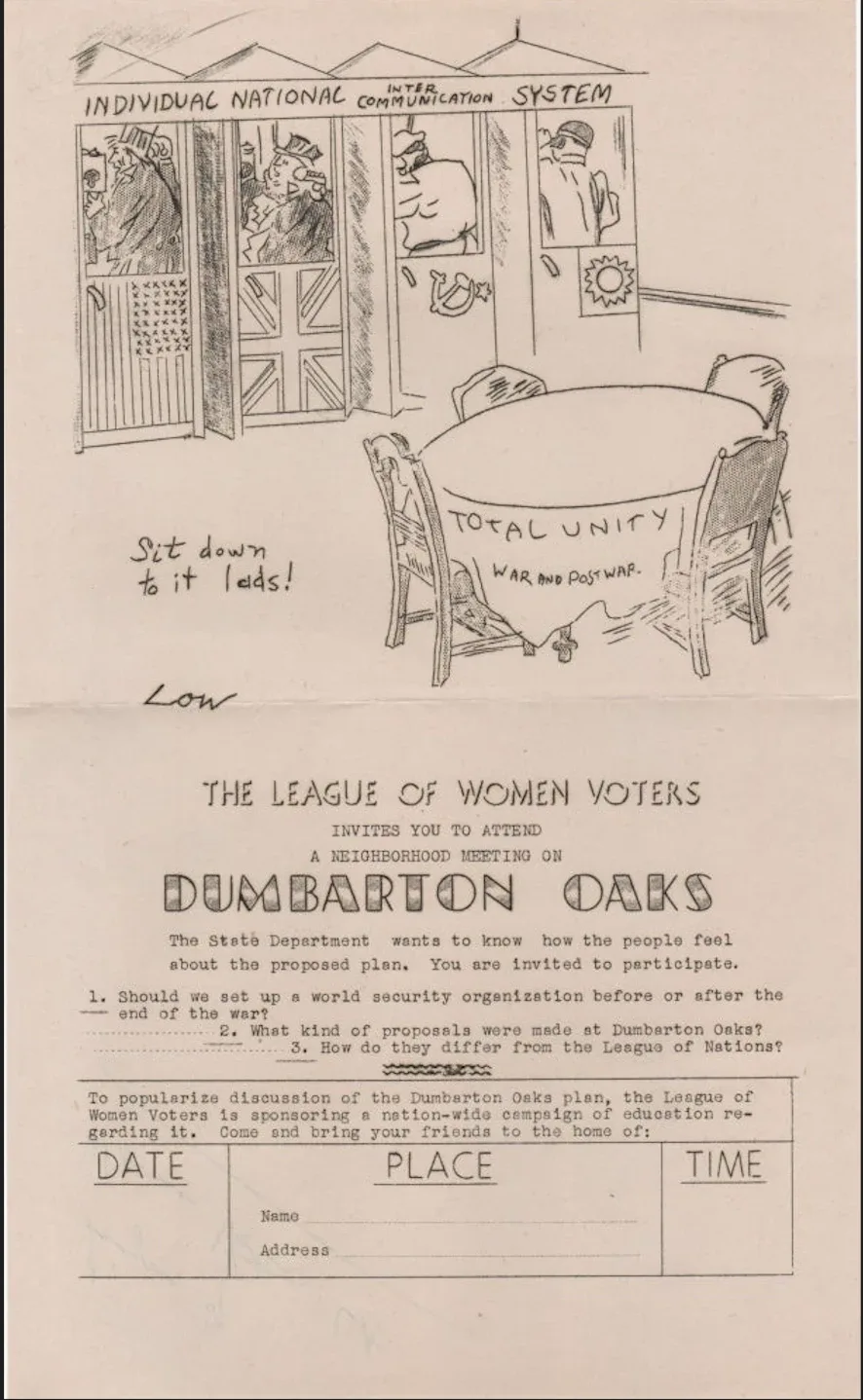
    A PTA in Klamath Falls. A church circle in Hillsboro. A book fair in La Grande. A high-school auditorium in Borger, Texas. The League of Women Voters printed invitations with blank lines for date, place and time, so anyone could host.

    Pins mark meetings documented in contemporary newspapers and church journals. There were many more.
  4. Public opinion

    The country moved.

    Asked whether the United States should join a union of nations to succeed the League, approval climbed from about one in four Americans in 1937 to nearly three in four by 1944.

    Polls cited by Arthur Sweetser, International Conciliation no. 409, March 1945.
  5. San Francisco

    42 organizations go to the conference.

    Groups as different as the NAACP, the American Farm Bureau Federation, the AFL and CIO, the Federal Council of Churches, the League of Women Voters and the Chamber of Commerce serve as consultants to the U.S. delegation.

  6. The text changes

    Human rights go in.

    Church conferences had asked for exactly this: a commission on human rights. Pressed by the consultants, the delegation backs stronger language, and the signed Charter names human rights among the UN's purposes.

  7. The Senate

    89 to 2.

    A public that had been asked, and had answered, sent a clear signal. The Charter was ratified with two votes against.

    Sources: Stephen C. Schlesinger, Act of Creation (2003); U.S. Senate roll call, 28 July 1945.

Then and now

We are not inventing this. We are bringing it back.

Every tool in our program has a 1945 ancestor. On the left, the real thing, from the winter the country studied the plan. On the right, what we are building for 2027.

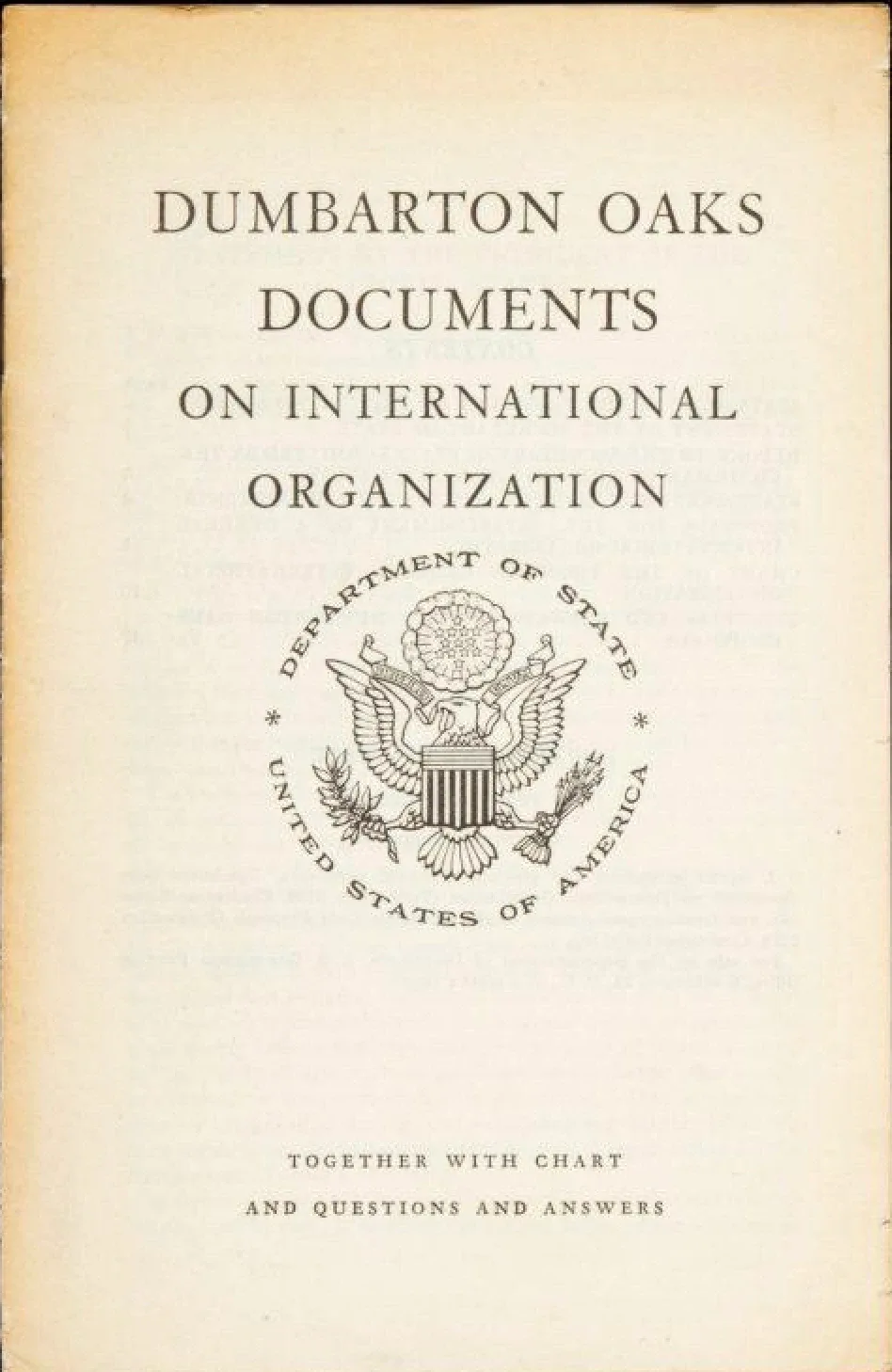
1945 Cover of Dumbarton Oaks Documents on International Organization, a 1944 State Department pamphlet.
The plan, in plain print. The full proposals, a chart, and questions and answers, printed for anyone to read.Department of State Publication 2192, 1944
2027

A free curriculum

Eight short modules, from “Multilateralism in a Day” to “What Should Change?” Written at a grade 8 reading level, every fact cited and dated, free to print.

1945 League of Women Voters invitation to a neighborhood meeting on Dumbarton Oaks, with blanks for date, place and time.
Anyone could host. “The State Department wants to know how the people feel about the proposed plan.” Blanks for date, place and time.League of Women Voters invitation, 1944–45
2027

A host kit anyone can use

A librarian, a pastor or a club president gets everything needed to run a 90-minute session: facilitator guide, readings, sign-in sheet and response forms. No experts flown in.

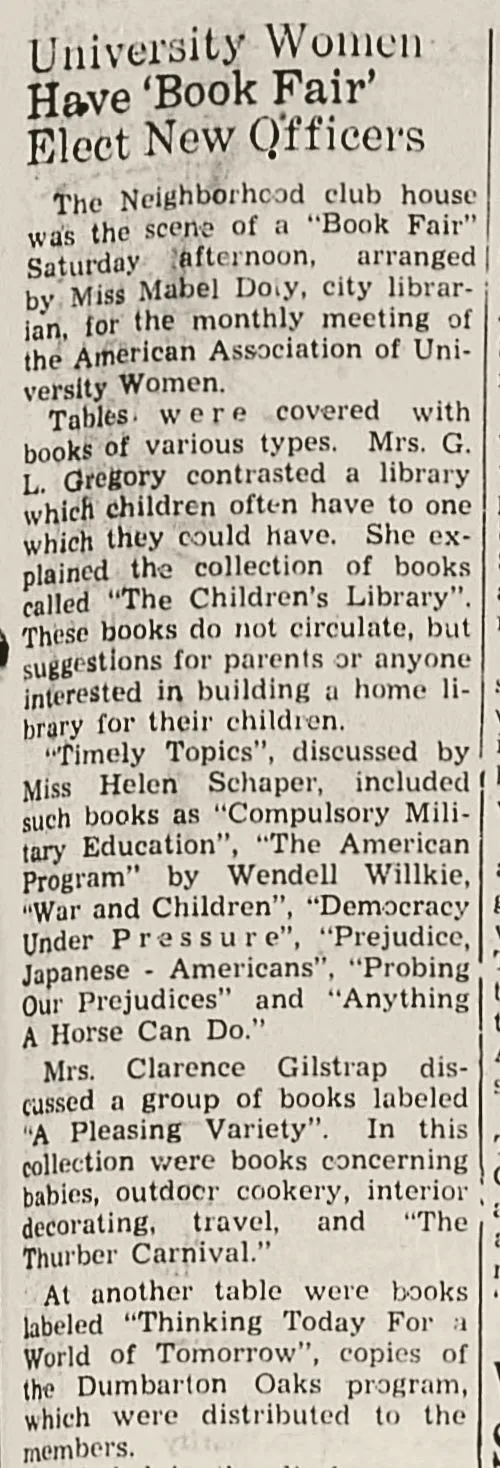
1945 La Grande Evening Observer notice of a library book fair with a table titled Thinking Today For a World of Tomorrow.
The library table. The city librarian lays out “Thinking Today For a World of Tomorrow,” with copies of the plan to take home.La Grande Evening Observer, 9 April 1945
2027

Library series

A monthly evening series at public libraries, a display table, and a reading list with voices from across the spectrum.

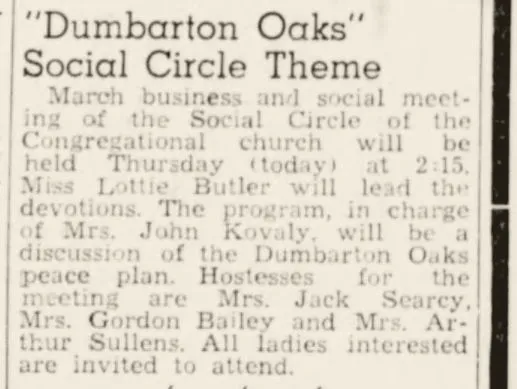
1945 Hillsboro Argus notice: Dumbarton Oaks is the theme of the Congregational church Social Circle.
The church circle. A Congregational church makes the plan the theme of its monthly meeting. “All ladies interested are invited.”Hillsboro Argus, 22 March 1945
2027

Faith communities

A values-based guide for churches, synagogues, mosques, temples and gurdwaras, with suggested readings from each tradition. Each community chooses its own texts.

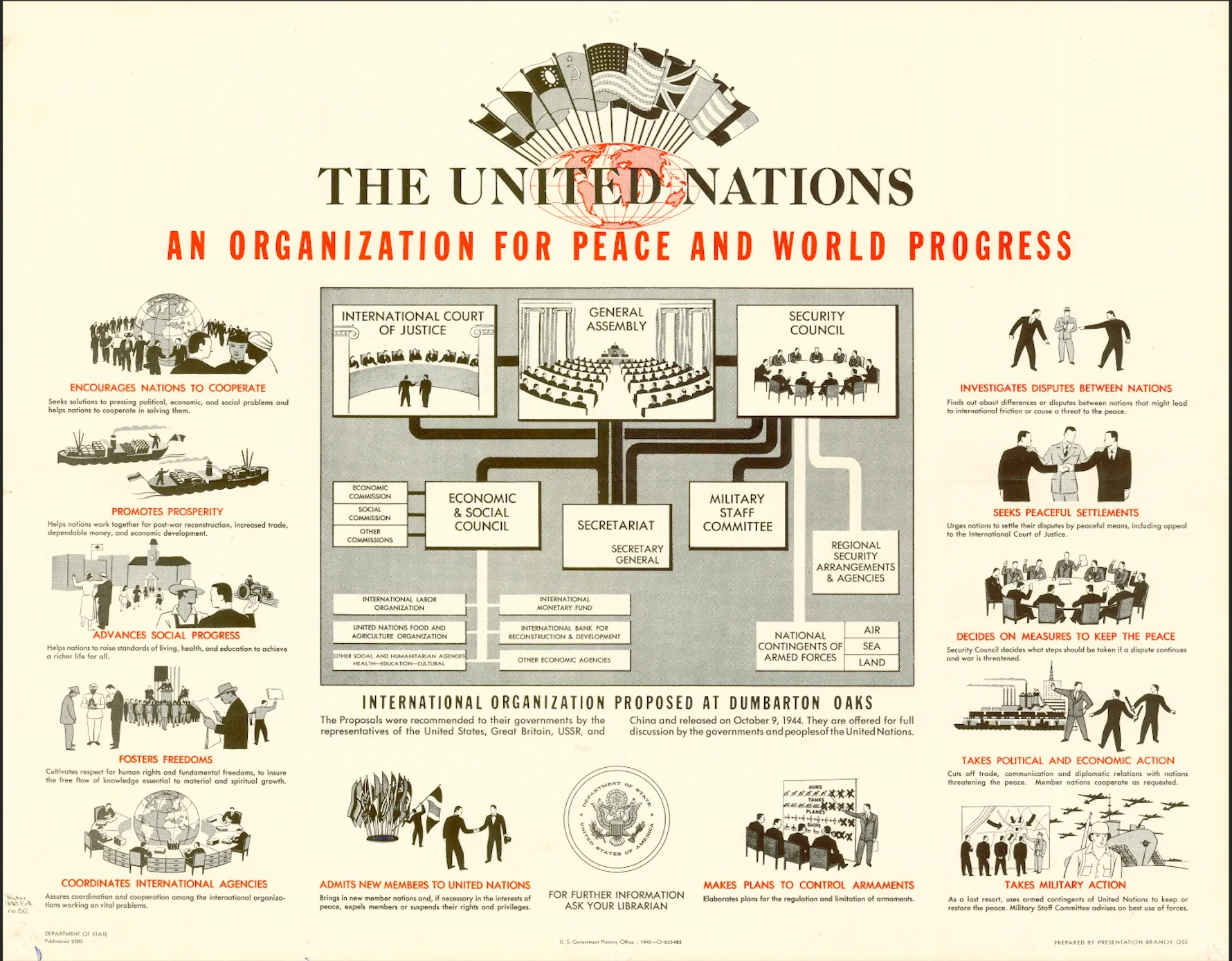
1945 1945 State Department poster explaining the proposed United Nations, ending with the line For further information ask your librarian.
The poster. The government’s own chart of the new organization ends: “For further information ask your librarian.”Department of State Publication 2280, 1945
2027

A traveling exhibition

“Multilateralism in a Day”: freestanding panels for library lobbies, town halls and transit stations, showing the cooperation hidden in an ordinary Tuesday.

See the exhibition ↓
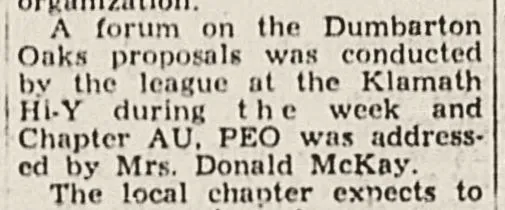
1945 Herald and News notice: a forum on the Dumbarton Oaks proposals was conducted at the Klamath Hi-Y.
The students. A forum on the proposals for high-school students at the Klamath Falls Hi-Y club.Herald and News, 14 April 1945
2027

Student hosts

Students run sessions for classmates who never joined a politics club, then take a five-question interview home to parents and grandparents.

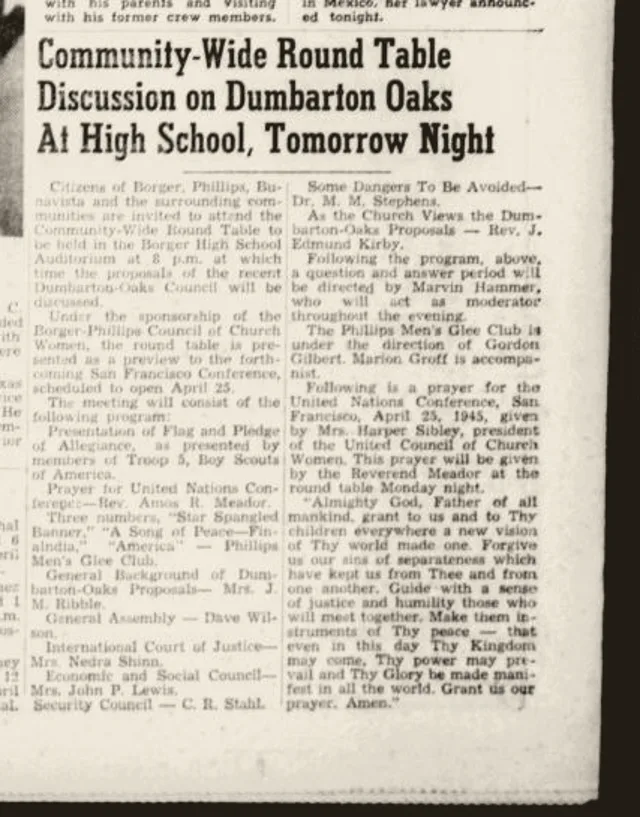
1945 Borger Daily Herald notice of a community-wide round table on Dumbarton Oaks at the high school, with local residents presenting each part of the plan.
The neighbors. In Borger, Texas, local residents each explain one part of the plan, then take questions from the floor.Borger Daily Herald, 22 April 1945
2027

Local messengers

Sessions are led by people the room already trusts, not outside speakers. The format is built for honest disagreement.

More from the archive
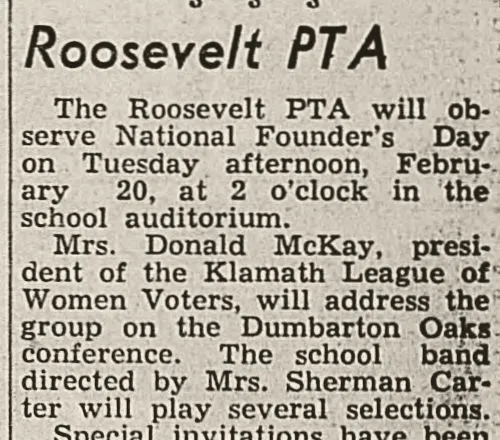
Klamath Falls newspaper notice: Roosevelt PTA to hear Mrs. Donald McKay on the Dumbarton Oaks conference.
Klamath Falls, OregonA PTA meeting in the school auditorium, with the school band.Herald and News, 17 February 1945
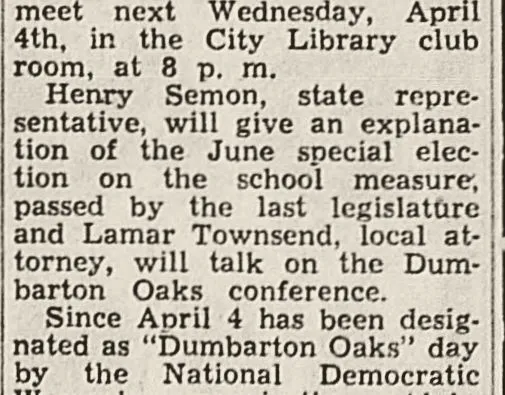
Klamath Falls notice of a meeting in the City Library club room on Dumbarton Oaks day.
Klamath Falls, OregonThe city library club room, on “Dumbarton Oaks day.”Herald and News, 31 March 1945
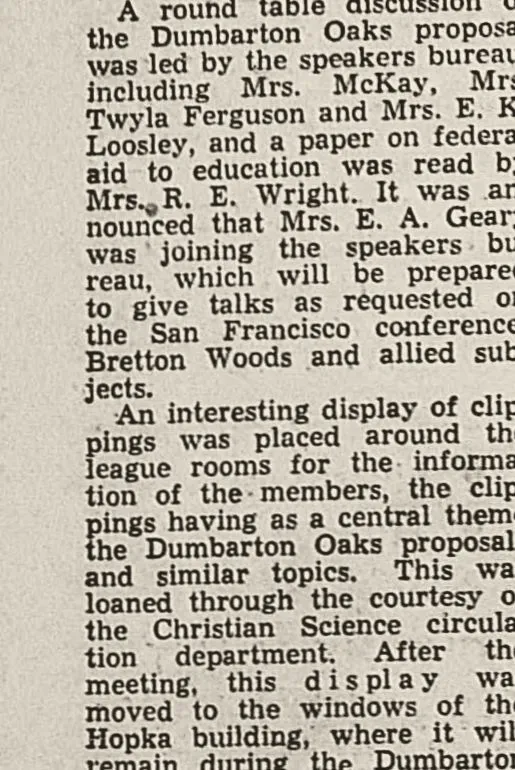
Klamath Falls notice: a round table discussion and a display of clippings moved to downtown shop windows.
Klamath Falls, OregonA round table, then a display of clippings moved into downtown shop windows.Herald and News, 21 April 1945
45denominations sent delegates to a church conference in Cleveland, 16 to 19 January 1945, devoted largely to the plan. It asked for a human rights commission.
Jan 9Berkshire County ministers in Stockbridge, Massachusetts, back the proposals, and suggest an international newspaper and university.
Jan 24The Episcopal diocese of Alabama, meeting in Mobile, calls on every parish and mission to study the plan.

Sources: Historic Oregon Newspapers (University of Oregon); The Portal to Texas History (UNT); International Conciliation no. 409 (Carnegie Endowment, March 1945); The Witness, 15 February 1945; The Living Church, 4 February 1945; National Archives; Department of State Publications 2192 and 2280.

The plan

What we are building.

01

A curriculum anyone can teach

Eight modules, one shared structure: start with something in your own town, look at the facts, work through the questions people actually ask, talk it through, and say what you think. Ninety minutes, or two 45-minute class periods.

SchoolsTwo 45-minute lessons per module, mapped to civics standards

Example: Module 1 in a high-school civics class

  1. Day 1, warm-up. “List ten things you used before lunch.” Students mark which ones depend on an agreement between countries.
  2. Day 1, read. A two-page briefing on weather data, flights and the post, written at a grade 8 level.
  3. Day 2, discuss. Small groups take one hard question each: “Who pays for this?” “Who sets the rules?”
  4. Take home. A five-question interview with a parent or grandparent. Answers come back to class.

Mapped to the C3 Framework for Social Studies, with a letter to parents explaining the approach.

LibrariesA monthly evening series, a display table and a reading list

Example: eight evenings at a branch library

  1. First Tuesday, 6:30 pm. One module per month, ninety minutes, coffee provided, no registration needed.
  2. The table by the door. A rotating display, in the spirit of La Grande’s 1945 table: two-page briefings to take home.
  3. The reading list. History and current affairs from across the spectrum, from Stephen Schlesinger’s Act of Creation to Paul Kennedy’s The Parliament of Man.

The librarian hosts; we supply the guide, signage, readings and sign-in sheets.

Faith communitiesA values-based guide, in each tradition’s own words

One question for every tradition: who is my neighbour, when what happens far away reaches us here?

  • Christian“And who is my neighbour?”Luke 10:29, the parable of the Good Samaritan
  • Jewish“Seek the peace of the city… for in the peace thereof shall ye have peace.”Jeremiah 29:7
  • Muslim“We made you into peoples and tribes, that you may know one another.”Qur’an 49:13
  • Hindu“Vasudhaiva Kutumbakam: the world is one family.”Maha Upanishad
  • Sikh“Sarbat da bhala: may all be blessed.”from the Ardas
  • Shared“They shall beat their swords into plowshares.”Isaiah 2:4, carved on the Isaiah Wall facing UN headquarters

Texts are suggestions. Each congregation chooses its own readings and leads its own session, in 45 or 90 minutes.

Civic groupsA 30-minute briefing that fits a regular meeting

Example: a Rotary lunch, a VFW post night, a farm bureau meeting

  1. 5 minutes. One local fact: how much of the county’s harvest is sold abroad, or where the post’s members served.
  2. 10 minutes. A frank briefing by a member, not an outside speaker: a veteran briefs veterans, a farmer briefs farmers.
  3. 15 minutes. Questions from the room, and a one-page response card to fill in before the coffee runs out.

In 1945, Rotary, the American Legion and the Farm Bureau federation were among the groups at San Francisco.

  1. Common TableMultilateralism in a DayModule 1
  2. Common TableWhat We Pay, What We GetModule 2
  3. Common TableKeeping the PeaceModule 3
  4. Common TableHealth Without BordersModule 4
  5. Common TableFood, Farms and AidModule 5
  6. Common TableRights and Who Judges ThemModule 6
  7. Common TableClimate and Shared ResourcesModule 7
  8. Common TableWhat Should Change?Module 8
02

A traveling exhibition

“Multilateralism in a Day” is a set of freestanding panels that stays for weeks in a station, a library, a stadium concourse. The front of each panel finds the cooperation hidden in an ordinary day. Turn it over for one of the big things countries have achieved together, and where to read more. Hover or tap a panel to turn it over.

  1. 06:10Your weather forecastBuilt from observations shared by almost every country on Earth.Multilateralism in a Day
    A big deal1987The ozone layer, healingEvery country on Earth ratified the Montreal Protocol, the first UN treaty ever to do so. The hole over Antarctica is on track to close by around 2066.Find out more ↗
  2. 08:45Your flightEvery pilot and controller follows the same rulebook.Multilateralism in a Day
    A big deal1980Smallpox, goneA disease that killed an estimated 300 million people in the 20th century was wiped out by a worldwide vaccination campaign coordinated through the WHO.Find out more ↗
  3. 11:00Your parcelA postal treaty from 1874 still gets it there.Multilateralism in a Day
    A big deal1948Human rights, written downThe Universal Declaration of Human Rights, drafted under Eleanor Roosevelt’s chairmanship, is one of the most translated documents in the world.Find out more ↗
  4. 13:30Your phone signalCountries agree who uses which frequency.Multilateralism in a Day
    A big deal1959A continent kept for peaceAt the height of the Cold War, twelve countries, the U.S. and the Soviet Union among them, agreed to keep Antarctica for peace and science. They still do.Find out more ↗
  5. 15:15Your flu shotLabs in over 100 countries pick the strains.Multilateralism in a Day
    A big deal1988Polio, nearly goneSince a global eradication drive began in 1988, polio cases worldwide have fallen by more than 99 percent.Find out more ↗
  6. 17:40Your groceriesOne shipping-safety convention, signed by nearly every flag state.Multilateralism in a Day
    A big deal1968Fewer nuclear powersThe Nuclear Non-Proliferation Treaty, now joined by 191 states, helped keep the number of nuclear-armed countries far below what experts feared in the 1960s.Find out more ↗
  7. Your turnIs it worth it?Scan to find a Common Table near you.
    Where it started1945The Charter51 nations signed the UN Charter in San Francisco. The U.S. Senate approved it 89 to 2.Find out more ↗
  1. Library lobbyWeeks 5 to 7
  2. Transit stationWeeks 7 to 9
  3. University atriumWeeks 9 to 11
  4. Town hallWeeks 11 to 13
  5. Church hallWeeks 13 to 15

Each stop runs two to four weeks, with a session calendar beside the panels. Route shown is illustrative.

03

One city. One season.

Take Kansas City: two states, one metro, a 2026 World Cup host city, and the hometown of Harry Truman, the president who signed the United States into the United Nations. The exhibition moves through the city and stays two weeks at a time where people already spend time: a train station, a museum, the main library, the convention center, a campus, a ballpark concourse, and finally Truman’s own presidential library. Around each stop, congregations, schools and a veterans’ hall host the conversations.

7
exhibition stops
14
session hosts
2
states
15
weeks
KANSASMISSOURI 5FGHBCDE7L6N Downtown → I A 1 K 4 2 3 J M DOWNTOWN
Dotted line: the exhibition’s route. Hover or tap a place.

Where the exhibition stays

  1. Union StationWeeks 1–2
  2. National WWI Museum and MemorialWeeks 3–4
  3. Kansas City Public Library, Central LibraryWeeks 5–6
  4. Kansas City Convention CenterWeeks 7–8
  5. University of Missouri–Kansas CityWeeks 9–10
  6. Kauffman StadiumWeeks 11–12
  7. Truman Library, IndependenceWeeks 13–15

Where sessions happen nearby

Faith communities

  • ACathedral of the Immaculate Conception
  • BChurch of the Resurrection, Leawood
  • CTemple B'nai Jehudah, Overland Park
  • DIslamic Society of Greater Kansas City
  • EHindu Temple and Cultural Center, Shawnee

Schools & campuses

  • FRockhurst University
  • GKU Medical Center, Kansas City, Kan.
  • HKansas City Kansas Community College
  • ILincoln College Preparatory Academy

Veterans & civic

  • JVFW National Headquarters

Stadiums & public spaces

  • KCity Market
  • LGEHA Field at Arrowhead Stadium
  • MCPKC Stadium
  • NChildren's Mercy Park

Illustrative: real places are named to show the range of rooms in one city. No partnership or endorsement is implied. Satellite imagery: Esri, Maxar, Earthstar Geographics, and the GIS User Community.

04

We don’t stop people. We stay where they are.

No clipboards, no petitions, no donation buckets. Common Table never asks a passer-by for anything. The exhibition simply stays put, for weeks, in the places people already spend time, so anyone can stop, read, and come back next week. Anyone who wants more finds it one scan away.

One evening at the ballpark

  1. Gates open.

    The panels stand on the main concourse, by the food lines, where people wait anyway.

  2. Between innings.

    A father reads “Your weather forecast” to his daughter. She turns the panel over: smallpox, gone.

  3. Seventh-inning stretch.

    Someone scans the code: the two-minute version on their phone, and the date of a session at the library down the road.

  4. A chair at the table.

    She comes to a Common Table at the Central Library, with neighbours she has never met.

The venue gives

A wall, a corner of the concourse, a few weeks. Its own name does the convincing: people trust their library, their ballpark, their station.

Visitors get

Something worth reading while they wait, and a way to learn more only if they want it.

We never

  • ask for money
  • ask for a signature
  • hand out party literature
  • stop anyone walking by

Nonpartisan by design

Not left. Not right. Plain.

Working with other countries was never a party idea. In 1945 the Charter passed the Senate 89 to 2. We teach how cooperation works and what it has achieved, in plain words, and we take people’s real questions seriously. No side, no candidate, no talking points.

  • No party, no candidate. We never name heroes or villains.
  • Every question answered with facts. Each one sourced and dated.
  • Every view welcome. Our advisory board spans the political spectrum.
  • Local, trusted hosts. Librarians, teachers, pastors and members, not outside experts.
  • Everything published. What people tell us goes into a public report.

The questions people actually ask

How much does our country pay?

About a fifth of the UN’s regular budget, set by a formula all member states agree to and based largely on the size of each economy. Sessions put that figure next to a local cost people know.

Can the UN override our laws?

No. The Charter itself protects matters “essentially within the domestic jurisdiction” of every country (Article 2), and the United States holds a veto on the Security Council.

Does it actually work?

Sometimes remarkably: smallpox is gone and the ozone layer is healing. Sometimes not, and we say so. Sessions look honestly at both.

Who decides what you teach?

Every module is reviewed by an advisory board drawn from across the political spectrum. Funders are listed publicly and have no say over content.

Every session ends the same way: what do you think?

Why the Centre for Youth Policy

Young people are the messengers. Everyone is the audience.

About half the people alive today are under 30, and they will live longest with whatever the world decides next. The Centre for Youth Policy studies how young people shape politics in 220 countries and territories. Here, we put them to work: student hosts run sessions for classmates who never joined a politics club, and every student who takes part brings the conversation home.

In 1945, high-school students in Klamath Falls held their own forum on the plan. In 2027, students host again.

The family interview · 5 questions · take it home

  1. When you were my age, what did “the world” mean to you?
  2. Has something that happened far away ever changed your life here?
  3. Which countries should we work with, and which should we be careful of?
  4. Is what our country pays into the UN worth it?
  5. What would change your mind?

Answers come back to class, and into the season's public report.

Why now

The system is being rewritten right now. The public isn't in the room.

  1. Pact for the Future

    World leaders adopt a pact on how the UN should change, including a Declaration on Future Generations.

  2. The UN turns 80

    A deep cash crisis forces budget and staff cuts, and a reform drive called UN80 puts every mandate on the table.

  3. A new Secretary-General

    Member states choose who leads the UN from 2027. Few people outside capitals follow the race.

  4. Common Table opens

    Season one asks ordinary people one question: what does working with the world mean for our town?

Flagship program

Common Table

A free, nonpartisan, ninety-minute conversation about whether international cooperation is worth it. In a library, a classroom, a church hall or a veterans' post near you.

  1. EncounterA pop-up exhibit or a meeting you already attend
  2. LearnTwo pages of facts, every one cited
  3. DeliberateThe hard questions, answered with facts
  4. ContributeYour view, anonymous, counted and delivered

What we do

Three ways in. One question.

i

Research

We track young people's place in politics across 220 countries and territories, and study what multilateralism looks like when you ask the generation that will inherit it.

Youth representation trackers · Reimagining Multilateralism Through a Youth Lens

ii

Young parliamentarians

Regional networks that put young elected representatives in the same room across borders, so cooperation has champions inside national parliaments.

Seven regional networks and the Global Emerging Leaders Forum

iii

Public conversation

Common Table takes honest, balanced conversations about global cooperation into the places ordinary people already gather, and carries what they say back to decision-makers.

Explore Common Table →

Young parliamentarians networks